AdsCrawl vs Scrapfly vs axiom.ai: Which Web Automation API Wins?
Compare AdsCrawl, Scrapfly, and axiom.ai for browser automation, scraping, and AI agents. See which API, cloud browser, or no-code bot fits your workflow.
AdsCrawl vs Scrapfly vs axiom.ai: Choosing the Right Browser Automation Tool
Modern teams face a crowded landscape of browser automation and web data platforms. Three tools often surface in evaluations: AdsCrawl, Scrapfly, and axiom.ai. Each takes a distinct approach to solving browser-based tasks—from raw API control to fully managed scraping infrastructure to no-code bot building. This comparison breaks down their core strengths, ideal users, and trade-offs so you can match a platform to your actual workflow.
How the Three Platforms Differ at a Glance
Scrapfly - Web Scraping API, Cloud Browser, Screenshot API product interface.
Before diving deep, understand the fundamental positioning of each tool.
- AdsCrawl delivers a unified API for real browser control. It provides cloud browser sessions with fingerprint profiles, concurrent execution, and direct Chrome DevTools Protocol access. The platform targets developers building AI agents, monitoring systems, and automation pipelines who need granular browser management.
- Scrapfly operates as a comprehensive web data platform. It combines anti-bot bypass, stealth Chromium over CDP, residential proxies, screenshots, and structured extraction behind a single API key. Its focus is reliability at scale for scraping teams.
- axiom.ai is a browser automation platform built for accessibility. Users can create bots with a no-code visual builder, write custom scripts via an SDK, or describe tasks to Claude. It runs on cloud infrastructure or locally, serving both non-technical professionals and developers.
Core Capability Comparison
Detection and association resistance.
Browser Automation and Control
Scrapfly offers a Cloud Browser endpoint that drives a real stealth Chromium instance over CDP. It maintains full Playwright and Puppeteer compatibility, making it a drop-in replacement for teams already using these frameworks. The browser fingerprints are designed to evade detection, and the infrastructure handles scaling automatically.
axiom.ai provides browser automation through three distinct paths. The no-code Chrome Extension uses a visual step builder for point-and-click bot creation. The code-based environment exposes a Chrome API—a long-lived WebSocket to a cloud browser drivable from Puppeteer, Playwright, or any CDP-speaking client. The AI-driven mode generates automations from natural language descriptions, lowering the barrier for non-developers.
AdsCrawl excels when teams need direct, programmatic control over browser sessions. Its API enables capturing screenshots, extracting HTML and Markdown, and managing remote CDP sessions with fingerprint profiles. This makes it particularly suitable for AI agent workflows where agents need to interact with pages dynamically and validate rendering states. For a practical walkthrough, see How to Use AdsCrawl: A Complete API Tutorial.
Web Scraping and Data Extraction
Scrapfly positions its Web Scraping API as the core unblocker. It fetches any URL with automatic anti-bot bypass, proxy rotation, and optional JavaScript rendering. The platform reports a 98% success rate on protected sites, measured weekly by its Scrapeway benchmark. Critically, Scrapfly only charges for successful requests—failed bypasses do not consume credits. The Extraction API further turns raw HTML into typed data using LLM-powered prompts or JSON schemas.
axiom.ai handles scraping through user-built bots. Its prebuilt steps cover common patterns like extracting data into Google Sheets, handling pagination, and managing conditional logic. The platform integrates deeply with Zapier, Make, n8n, and various AI models, allowing scraped data to flow into broader automation pipelines. The AI builder can generate a scraper from a simple description like "Get every job listing from this careers page."
AdsCrawl provides the browser infrastructure that scraping workflows can be built upon. Its real browser capabilities ensure pages render fully, including JavaScript-heavy sites. Teams can collect public web pages at scale and validate page rendering states before extraction. However, AdsCrawl does not bundle anti-bot bypass or structured extraction as first-party features, making it better suited for teams that already have their own scraping logic or need raw page access for AI processing. For AI-driven extraction patterns, explore How to Use AdsCrawl with ChatGPT for AI-Powered Web Data.
Screenshot Capabilities
Scrapfly offers a dedicated Screenshot API supporting full-page, viewport, or element-level captures in PNG, JPEG, or WebP formats. It includes ad-blocking, cookie-banner dismissal, and custom viewport sizing.
AdsCrawl provides screenshot capture as a core API function alongside HTML and Markdown extraction. This unified approach means a single API call can return both the visual state and the structured content of a page, which is valuable for monitoring and validation workflows.
axiom.ai can capture screenshots as part of bot workflows, but it does not offer a standalone screenshot API. Screenshots are typically one step within a larger automation rather than a dedicated service.
AI Agent Support
Scrapfly has invested heavily in AI agent infrastructure. Its AI Browser Agent endpoint provides stealth Chromium tuned for autonomous agent loops, compatible with Browser Use, Stagehand, and Vibium. The MCP Server connects any MCP client—including Claude, Cursor, and ChatGPT—to scrape, screenshot, extract, and crawl with one API key.
AdsCrawl positions itself as browser infrastructure for the AI era. Its CDP sessions and fingerprint profiles give AI agents the ability to control real browsers programmatically. The credit-based freemium model allows teams to experiment without upfront commitment. For teams building custom AI agents that need direct browser control, AdsCrawl provides the foundational layer.
axiom.ai integrates AI differently. Its "build by description" feature uses Claude to generate automations from natural language. This makes AI the builder rather than the end user of the browser. For teams wanting AI to create automations rather than execute them, this approach reduces development time significantly.
Pricing and Usage Models
Collection and archiving.
Understanding how each platform charges helps forecast costs for your specific workload.
- Scrapfly uses a credit-based system where pricing scales with the actual complexity of each target. The key differentiator: failed bypasses are free. This pay-on-success model protects your budget when targeting difficult sites. A free tier with 1,000 credits is available without a credit card.
- axiom.ai starts at $15 per month with a free trial and free version available. The pricing reflects its focus on accessibility and broad user adoption, with over 300,000 users and 800,000 bots executed.
- AdsCrawl operates on a credit-based freemium model. Teams can start with free credits and scale usage as needed. The dashboard provides visibility into key management, usage tracking, and debugging.
Integration Ecosystem
axiom.ai leads in integration breadth. It connects natively with Google Sheets, Microsoft Excel, Zapier, Make, n8n, and AI models including Claude, Gemini, and DeepSeek. Webhooks enable custom integrations with any tool that can send or receive HTTP requests. This makes axiom.ai a natural fit for teams already invested in no-code or low-code automation stacks.
Scrapfly provides SDKs for Python and TypeScript, plus integrations with Zapier and Make. Its MCP Server extends compatibility to AI coding assistants and agents. The platform is developer-first, with extensive documentation and API references.
AdsCrawl offers quick-start examples in cURL, Node.js, and Python. Its API-first design integrates into existing developer workflows without requiring new tools or platforms. For a deeper comparison with other API-based solutions, see AdsCrawl vs Browserless vs axiom.ai: Which Browser API Wins?.
Which Tool Fits Your Team?
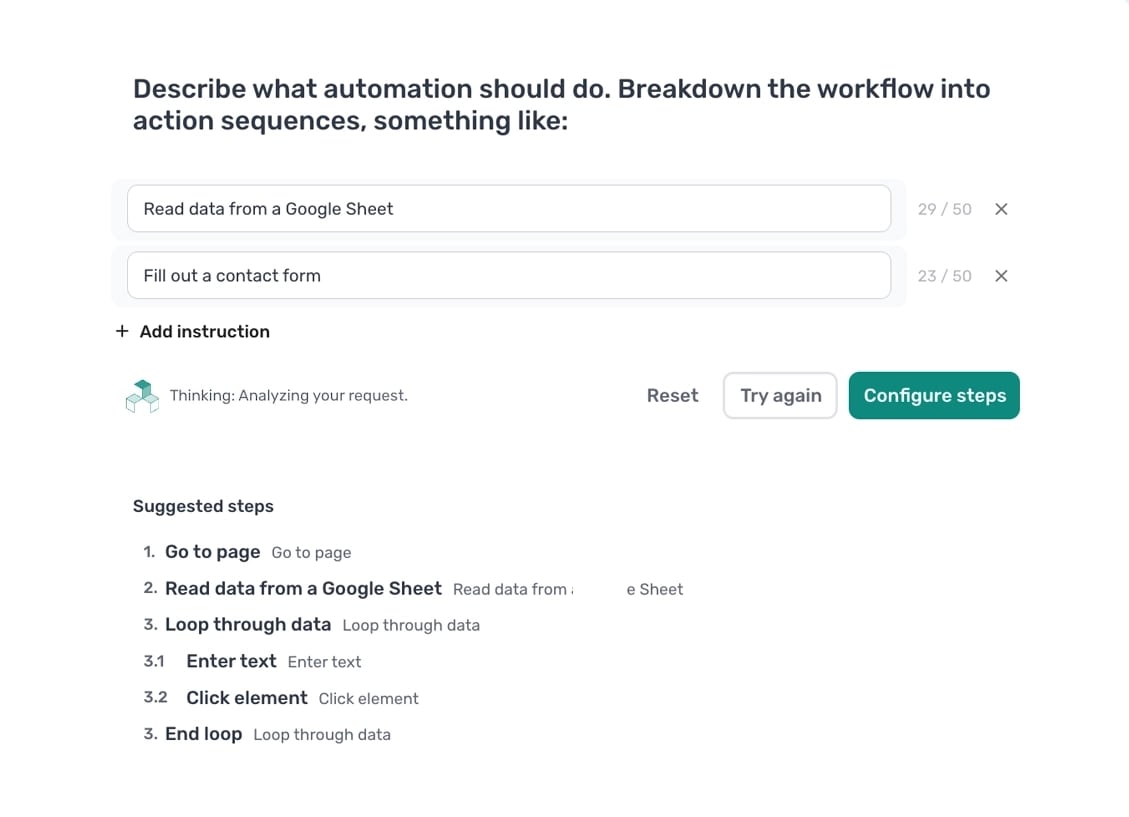
Describe the bot you wish to build to the AI and it will make it - axiom.ai.
Choose based on your primary workflow and technical profile.
Choose Scrapfly if:
- Your primary goal is scraping protected sites at scale
- You need anti-bot bypass and residential proxies built in
- You want to pay only for successful requests
- You need structured extraction from raw HTML using AI
- You are a development team that values observability and stack ownership
Choose axiom.ai if:
- You need non-developers to build and run browser automations
- You want a no-code visual builder or AI-generated bots
- Your workflows involve form filling, data entry, or multi-step business processes
- You need deep integrations with Google Sheets, Zapier, or Make
- You want the flexibility to run bots locally or in the cloud
Choose AdsCrawl if:
- You are building AI agents that need direct browser control via CDP
- You need a unified API for screenshots, HTML, and Markdown extraction
- Your team wants fingerprint profiles and concurrent browser execution
- You prefer a credit-based freemium model for experimentation
- You need browser infrastructure that integrates into custom automation pipelines
Related reading
- GoLogin Review 2025: Anti-Detect Browser Tested - Evidence-based GoLogin review covering fingerprinting, multi-account management, pricing, security concerns, and ideal use cases for marketers and e-commerce.
Sources and further reading
- Scrapfly - Web Scraping API, Cloud Browser, Screenshot API - Power web scrapers and AI agents with Scrapfly's web data platform. One API key for anti-bot bypass, stealth Chromium over CDP, residential proxies, screenshots, and structured extraction.
- Compare Axiom.ai vs. ScrapFly in 2026 - What’s the difference between Axiom.ai and ScrapFly? Compare Axiom.ai vs. ScrapFly in 2026 by cost, reviews, features, integrations, and more
- Browser automation & web scraping, no-code or code - Automate any website with our no-code tool, our browser automation API, or by describing it to Claude. Axiom runs on our cloud or your machine.
FAQ
Can I use these tools without writing code?
axiom.ai is the strongest choice for no-code users, offering a visual step builder and an AI mode that generates bots from natural language. Scrapfly and AdsCrawl are API-first platforms requiring programming knowledge.
Which platform handles anti-bot detection best?
Scrapfly specializes in anti-bot bypass with proprietary stealth engines and reports a 98% success rate on protected sites. It also offers residential proxy rotation and only charges for successful requests.
Do these platforms support AI agent workflows?
Yes, all three support AI agents differently. Scrapfly offers a dedicated AI Browser Agent endpoint and MCP Server. AdsCrawl provides CDP sessions and fingerprint profiles for custom AI agents. axiom.ai uses Claude to build automations from descriptions.
Can I run browsers locally?
axiom.ai supports local execution through its desktop application. AdsCrawl and Scrapfly are cloud-based platforms, though Scrapfly's Cloud Browser can be driven by local Playwright or Puppeteer scripts.
What about screenshot capabilities?
Scrapfly and AdsCrawl both offer dedicated screenshot functionality. Scrapfly provides a standalone Screenshot API with format options and banner dismissal. AdsCrawl includes screenshots as part of its unified browser API alongside content extraction.
Making the Final Decision
Your choice ultimately depends on where browser automation fits in your stack. If scraping protected sites at scale is your core challenge, Scrapfly's anti-bot infrastructure and pay-on-success model deliver clear value. If you need to empower a mixed team of technical and non-technical users to automate browser tasks, axiom.ai's multi-modal builder approach is unmatched. If you are building AI agents or custom automation pipelines that require direct, programmatic browser control with fingerprint management, AdsCrawl provides the infrastructure layer you need.
For teams evaluating multiple API-based solutions, the AdsCrawl vs Scrapfly vs Browserless comparison offers additional perspective on how these platforms stack up against another popular alternative. And if you are coming from a Playwright background, AdsCrawl vs Playwright explores the trade-offs between a cloud browser API and a local testing framework.