Browserless Review 2025: Headless Browser API Tested
Evidence-based Browserless review covering stealth scraping, AI agents, Playwright & Puppeteer support, pricing, and real-world performance for developers.
Browserless Review: The Headless Browser Platform for Developers Who Hate Infrastructure
Managing your own fleet of headless Chrome instances is a special kind of pain. Memory leaks, zombie processes, IP blocks, and constant security patching turn a simple scraping job into a full-time operations role. Browserless promises to eliminate that overhead entirely by offering a managed headless browser platform accessible through a single API endpoint. But does it deliver enough value to justify its seat at the table alongside tools like ScrapingBee or AdsCrawl? After testing the service across multiple real-world automation workflows, here is what you need to know.
What Is Browserless?
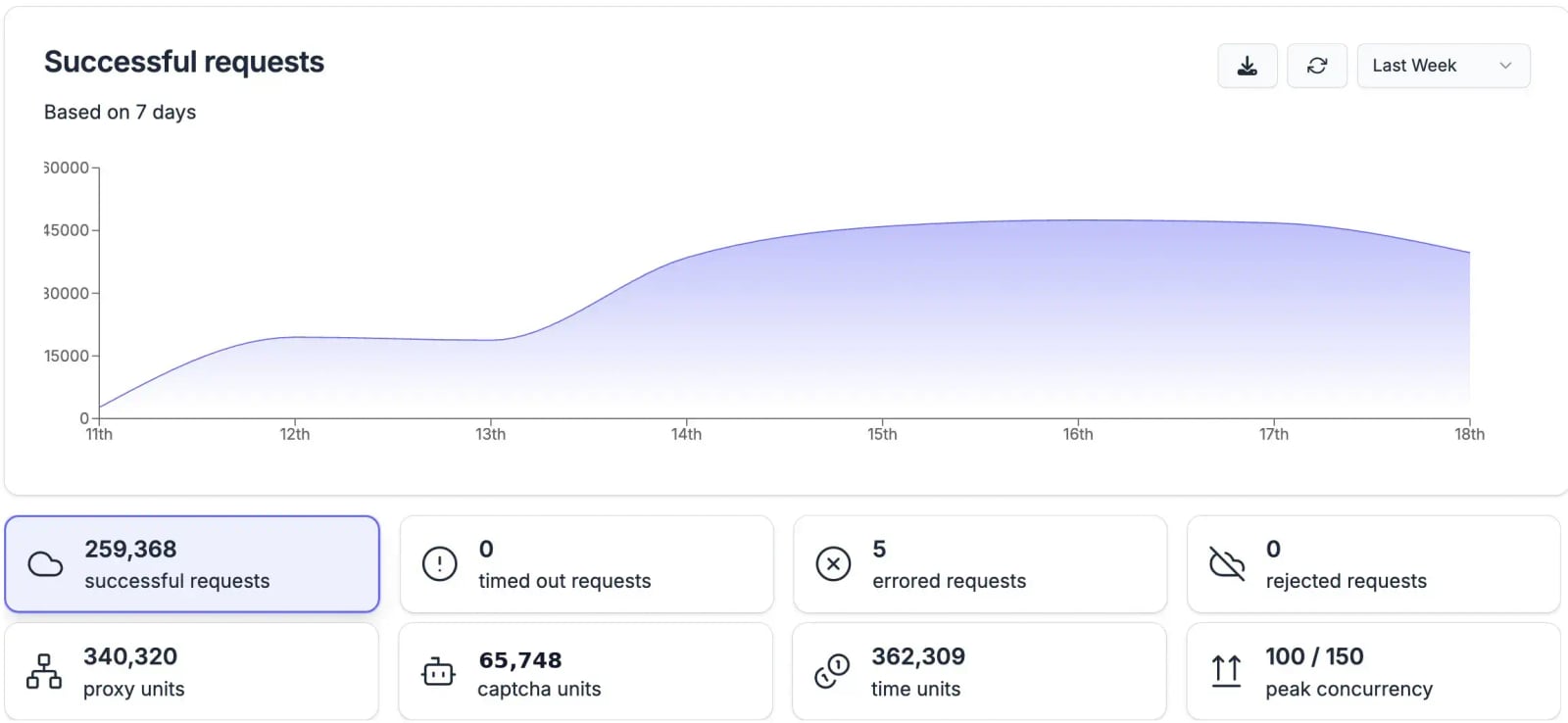
Browserless product interface.
Browserless is a production-grade headless browser service that lets developers run Puppeteer, Playwright, and other Chrome DevTools Protocol (CDP) workloads without owning the underlying servers. Instead of wrestling with Docker containers or Kubernetes clusters, you connect to Browserless via a WebSocket endpoint and let the platform handle scaling, health checks, concurrency, and browser lifecycle management.
The service has grown well beyond a simple remote browser. It now ships with built-in stealth mode, CAPTCHA solving, session reconnection, authenticated profiles, and support for the Model Context Protocol (MCP), making it a viable backbone for AI agents that need to interact with live web pages. With over 160 million Docker pulls and a claimed 99.9% uptime, it has clearly found product-market fit among developers who would rather ship features than babysit browsers.
Ideal Users and Core Use Cases
Browserless Review 2025: Headless Browser API Tested - Ideal Users and Core Use Cases.
Browserless is not a no-code scraper. It is a developer-first platform, and it shows in every part of the product experience. The ideal user is a software engineer who already knows how to write Puppeteer or Playwright scripts and wants to offload execution to a reliable cloud service.
Web Scraping at Scale
This is the most common use case. Browserless handles JavaScript-heavy sites, single-page applications, and login-walled portals without requiring you to manage proxy rotation or headless detection separately. The platform’s stealth mode helps scripts blend in with regular traffic, which is critical when targeting modern anti-bot systems.
AI Agent Automation
With the rise of AI agents that need to browse the web, Browserless has positioned itself as the browser runtime for tools like ChatGPT plugins, LangChain agents, and custom MCP servers. Instead of building a browser abstraction from scratch, AI developers can pipe web content directly into their models through Browserless.
Automated Testing
While Browserless started as a scraping-focused alternative to testing-oriented services, it is perfectly capable of running end-to-end test suites. Teams that already use Playwright or Puppeteer for testing can shift execution to Browserless and free up CI/CD runners from the heavy lifting of browser rendering.
PDF and Screenshot Generation
Generating pixel-perfect PDFs from HTML is notoriously tricky. Browserless handles this reliably, making it a solid choice for invoice generation, report rendering, and any workflow that needs to turn web content into printable documents.
Setup and Developer Experience
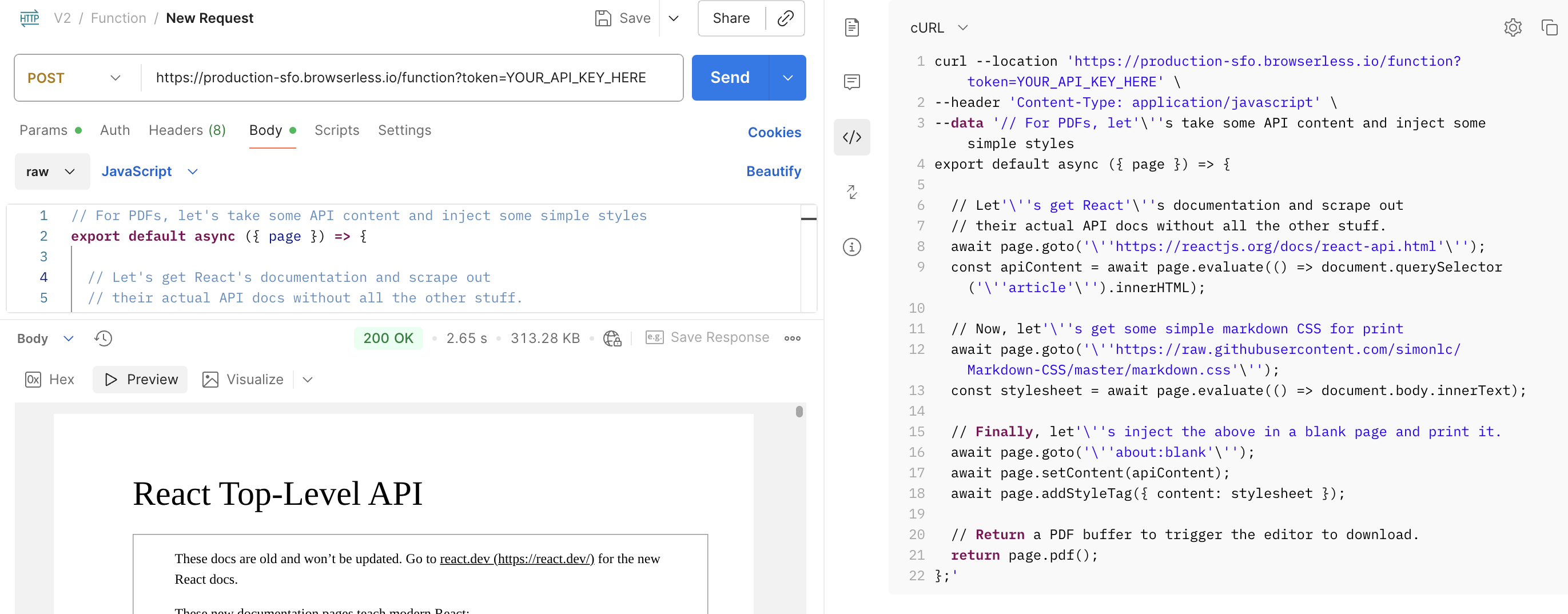
Browserless Review 2025: Headless Browser API Tested - Setup and Developer Experience.
Getting started with Browserless is refreshingly simple. You sign up, grab an API token from the dashboard, and swap your local Puppeteer or Playwright connection string for a Browserless WebSocket endpoint. The code change is often a single line.
import puppeteer from "puppeteer-core";

const browser = await puppeteer.connect({
  browserWSEndpoint: `wss://production-sfo.browserless.io?token=YOUR_TOKEN`,
});
This minimal migration path is one of Browserless’s strongest selling points. You do not need to learn a proprietary SDK or rewrite your existing scripts. If your code runs on a local Chrome instance, it will almost certainly run on Browserless with zero modifications.
The platform offers regional endpoints in the US and Europe, which helps reduce latency when targeting geo-specific content. For enterprise customers with strict data residency requirements, private cloud and self-hosted deployment options are available.
Key Strengths
Browserless Review 2025: Headless Browser API Tested - Key Strengths.
Infrastructure Abstraction Done Right
Browserless removes the entire browser infrastructure layer. You never think about memory limits, process supervisors, or Chrome version updates. The platform handles concurrency automatically, queuing requests when demand spikes and scaling resources behind the scenes.
Stealth and Anti-Detection
The built-in stealth mode applies a set of evasion techniques that make headless Chrome appear more like a regular user-driven browser. While no solution guarantees 100% invisibility against advanced anti-bot platforms, Browserless significantly reduces the fingerprinting surface that triggers blocks.
Session Reconnection and Persistence
Long-running scraping jobs or agent workflows can reconnect to existing browser sessions if a connection drops. This is invaluable for tasks that require maintaining authentication state or navigating multi-step workflows where restarting from scratch would be costly.
Security and Compliance Posture
Browserless has invested heavily in enterprise readiness. The platform holds a SOC 2 Type II certification, complies with GDPR, and offers HIPAA-compatible deployments through private cloud or self-hosted options. A Data Processing Addendum (DPA) and Business Associate Agreement (BAA) are available for enterprise plans, which matters a lot if you are handling sensitive data. All data in transit uses TLS encryption, and datastores are encrypted at rest.
Active Community and Open-Source Roots
The open-source Browserless project has accumulated over 160 million Docker pulls, which speaks to a massive community of self-hosted users. Many of those users eventually convert to the managed cloud service when they tire of maintaining their own instances. This open-source foundation means the platform benefits from broad library compatibility and community-contributed debugging knowledge.
Limitations and Trade-Offs
Pricing Can Surprise You
Browserless does not publish transparent, per-request pricing on its public website. Plans are usage-based, and costs scale with concurrency and session duration. For low-volume hobby projects, the free tier provides enough access to test the service thoroughly. For production workloads, you will need to contact sales or monitor your dashboard closely to avoid unexpected bills. This opaqueness is a common friction point, especially when comparing Browserless against competitors like AdsCrawl vs Scrapfly vs axiom.ai that offer more predictable pricing models.
Not a No-Code Solution
If you need a point-and-click scraper or a visual workflow builder, Browserless is the wrong tool. It assumes you are comfortable writing code and managing your own automation logic. The platform provides the browser; you provide everything else.
Learning Curve for Advanced Features
While basic setup is trivial, unlocking the full power of stealth mode, authenticated profiles, and MCP integration requires reading documentation and understanding how Browserless’s session management works. The docs are solid, but the surface area is large.
Regional Availability
Currently, Browserless offers endpoints in the US and Europe. If you need to scrape websites that are only accessible from Asia-Pacific or other regions, you may face latency issues or need to combine Browserless with a separate proxy solution.
Pricing Signals and Decision Criteria
Browserless operates on a tiered model with a free tier for evaluation. Paid plans unlock higher concurrency, longer session timeouts, and enterprise features like SSO and dedicated support. The exact cost depends on your usage patterns, which makes it important to run a realistic pilot before committing.
When evaluating Browserless against alternatives, consider these decision points:
- You already use Puppeteer or Playwright: Browserless is a natural fit. The migration cost is near zero.
- You need enterprise compliance: SOC 2, GDPR, HIPAA, and DPAs are available. Few competitors match this compliance breadth.
- You are building AI agents: MCP support and session reconnection make Browserless a strong candidate for agentic workflows.
- You want predictable, per-request pricing: Look at alternatives with transparent pricing pages before committing to a usage-based model.
- You prefer a fully managed scraping API with built-in parsers: Tools like ScrapingBee abstract even more of the pipeline and may be a better fit if you do not need raw CDP access.
For a deeper feature-by-feature breakdown, the comparison in AdsCrawl vs Browserless vs axiom.ai walks through where each platform shines.
Related reading
- GoLogin Review 2025: Anti-Detect Browser Tested - Evidence-based GoLogin review covering fingerprinting, multi-account management, pricing, security concerns, and ideal use cases for marketers and e-commerce.
- AdsCrawl vs Playwright: Which Browser Tool Fits Your Stack? - Compare AdsCrawl's cloud browser API with Playwright's testing framework. See which fits AI agents, scraping, and automation with less maintenance.
Sources and further reading
- I run a headless browser service called browserless.io. Got started due to lack ... - I run a headless browser service called browserless.io. Got started due to lack of a comparable service, and all others seemed more geared for testing.
- Security, Compliance & Trust Center | Browserless - Security, compliance, and privacy at Browserless. Learn about our SOC 2 Type II certification, GDPR compliance, encryption practices, and more.
- Quickstart | Browserless Documentation - Connect to Browserless using Puppeteer or Playwright via Chrome DevTools Protocol websockets for stable browser automation.
Frequently Asked Questions
Does Browserless support Playwright, or is it Puppeteer-only?
Browserless fully supports both Puppeteer and Playwright through the Chrome DevTools Protocol. You can connect using either library without changing the platform configuration.
Is there a free tier available?
Yes. Browserless offers a free tier that lets you test the service with limited concurrency and session duration. It is sufficient for evaluation and small personal projects.
How does Browserless handle CAPTCHAs?
Browserless includes built-in CAPTCHA solving capabilities as part of its stealth feature set. This reduces the need to integrate a separate third-party solving service.
Can I use Browserless for tasks that require logged-in sessions?
Yes. Authenticated profiles allow you to persist cookies and local storage across sessions, which is essential for scraping data behind login portals or maintaining state in multi-step workflows.
Where is customer data stored?
Customer data is primarily stored in the United States via AWS, DigitalOcean, and Supabase. Enterprise customers with data residency requirements can discuss private cloud or self-hosted deployment options with the sales team.
Does Browserless offer a SOC 2 report?
Yes. Browserless maintains a SOC 2 Type II report that validates the effectiveness of its security and operational controls. Customers can request the report for vendor review processes.
Conclusion: Who Should Use Browserless?
Browserless solves a real and painful problem for developers who need reliable headless browsers without the operational burden. Its strengths lie in infrastructure abstraction, broad library compatibility, and a compliance posture that satisfies enterprise security teams. The platform is particularly well-suited for teams running Puppeteer or Playwright scripts in production, AI developers building browsing agents, and anyone who has spent too many hours debugging Chrome process crashes at 2 AM.
The main friction points are pricing transparency and the assumption that you are a developer comfortable with code. If those do not deter you, Browserless is one of the most mature and capable managed browser platforms available today. Run a pilot on the free tier, stress-test your most demanding workflows, and see if the infrastructure relief justifies the cost. For most engineering teams, it will.